AI agents do more than just respond to inquiries. They free teams up for more difficult tasks, such as resolving tickets and processing refunds. How quickly you’ll use them is the big question.
***
Imagine this: your inbox is full to the brim. Overnight, a hundred support tickets arrived. questions regarding shipping, requests for refunds, and password resets. Even though your team hasn’t logged in yet, customers have already requested responses.
Now, suppose that half of those tickets are resolved before anyone enters the line. Issued refunds. Updated accounts. sent tracking links. Software that knows what to do, not a person clicking through screens. That’s what AI agents promise. AI agents are more than just chatbots that speak more politely.
They are autonomous programs that can understand context, make decisions, and complete tasks. They are called digital workers. I’ll explain what an AI agent is, how it differs from traditional automation, and why businesses are betting big on them right now in this piece. The AI Agent is moving forward because of the pressure. Support leaders are under pressure. Customer expectations continue to rise, including immediate responses, personalized service, and 24/7 availability of all channels.
Meanwhile, headcount and budgets are not keeping up. Hire more agents and produce more scripts is no longer scalable. Slower responses, longer wait times, and exhausted teams are all consequences of manual labor. For a while, chatbots were helpful, but customers quickly realized their limitations. AI agents help with this. They act rather than waiting for instructions. When things get too complicated, they can pull a policy, check an order, process a refund, or escalate.
Advances in artificial intelligence and agent technology have made it possible for AI agents to operate independently and automate routine tasks that previously required human effort. AI agents are important right now because of this shift from answering to doing. AI agents, in contrast to conventional automation tools, perform routine tasks that used to necessitate human intervention and operate independently, adapting in real time.
What exactly is an AI agent and how does it carry out tasks?
An AI agent is fundamentally software that is capable of acting on its own. A new breed of AI systems known as intelligent and autonomous agents are able to make decisions on their own, learn from their experiences, and adapt to their surroundings. It takes in information, decides what to do, and does it instead of waiting for a human to click a button or follow a script. It is more like a digital colleague than a chatbot.
There are three moving parts in every AI agent: It reads inputs, such as a customer message, a database, or a live system feed, through perception. Reasoning: it looks at the situation and weighs the options.
Should a policy be obtained? Reach out to an agent? Start a workflow?
Action: It performs the subsequent action, such as sending a refund, contacting the customer, or updating an account.
What does an AI agent do?
They process information using sophisticated algorithms, collect data from external systems, and make decisions on their own, frequently without the assistance of a human. AI agents depart from conventional automation at this point. Rules were followed by old tools: if this, then that. The same thing happened a lot with chatbots, which provided pre-written responses in a more user-friendly interface.
AI agents can learn and change over time, in contrast to traditional AI models that can’t change and need input from humans. In addition, AI agents are more advanced than AI assistants because they can take proactive actions to achieve goals and have more autonomy. They change. They can adapt to customer history, learn from your company’s data, and know when to stop and hand off to a human.
AI agents are able to learn on a continual basis, enhancing their performance over time by gaining insight from previous interactions. They are more than just another automation layer because they are able to combine autonomy with judgment. AI agents’ capacity to learn, improve, and make more informed decisions will continue to advance as machine learning, large language models (LLMs), and NLP tools continue to advance.
AI agents’ characteristics The term « AI agent » refers to intelligent systems that are built to work independently, adapt to new circumstances, and collaborate with other agents as well as humans. AI agents are more than just automated scripts. The following distinguishes advanced AI agents and makes them so useful in today’s business environments: autonomy and a focus on the end goal Autonomy is at the heart of every AI agent.
These autonomous agents make decisions and carry out actions without constant human supervision. AI agents are programmed to pursue specific objectives and evaluate each action to maximize results, whether they are handling customer inquiries or managing complex workflows. Sensitivity and adaptability Digital inputs, such as customer data, sensor data, or real-time system feeds, enable AI agents to interact with their surroundings.
They are able to recognize changes, update their internal state, and respond appropriately thanks to this perception. Adaptability is essential in dynamic settings like supply chain operations or customer management systems. AI agents are able to change their strategies on the fly, making sure that they work even when things change. Questions for customer service interviews Making decisions with logic. Advanced AI agents combine sensor data, domain knowledge, and previous interactions to make informed decisions, in contrast to simple reflex agents that adhere to predefined rules.
They are able to resolve a support ticket, optimize logistics, or identify a security risk thanks to this rationality, which enables them to analyze intricate data, identify patterns, and select the best course of action. proactiveness and ongoing learning Advanced AI agents anticipate rather than simply react. They can anticipate future events and take proactive measures, such as preventing system outages or personalizing customer outreach, by utilizing predictive models and machine learning techniques.
These agents are able to continuously improve their performance, refine their behavior, and adapt to new challenges over time through continuous learning from previous interactions. Systems for collaboration and multiple agents Numerous business processes necessitate the cooperation of multiple agents. AI agents work together, communicate, and coordinate in multi-agent systems to tackle challenging tasks that would overwhelm a single agent.
In customer service, for instance, one agent might deal with initial inquiries while another might be more skilled in technical troubleshooting, sharing context and insights at the same time. generative AI and natural language processing Conversational agents are able to comprehend, interpret, and produce language that is human-like thanks to the integration of generative AI and natural language processing (NLP). Delivering seamless customer experiences, automating routine tasks, and even rapidly developing new content or solutions all depend on this.
Flexibility and specialization Model-based reflex agents for predictive analytics or utility-based agents for decision-making under uncertainty are examples of AI agents that can be tailored to specific tasks. Businesses can use this specialization to deploy AI agents that are specifically tailored to their distinct workflows, such as automating time-consuming customer support processes or managing intricate software development pipelines.
Intelligent AI and human oversight Responsible AI practices are crucial as autonomous AI agents become more advanced. Agents are supervised by humans to make sure they act ethically, openly, and in accordance with the values of the organization. Advanced AI systems incorporate mechanisms for accountability, fairness, and privacy, particularly when handling sensitive customer data, in order to maintain trust and compliance.
Automation and integration. By interacting with external tools, customer management systems, and other software, AI agents excel at automating complex workflows. There are significant cost savings, increased productivity, and more consistent outcomes as a result of this ability to carry out tasks across multiple platforms. Memory and learning AI agents are constantly getting better thanks to their long-term memory and ability to learn from experience.

They use this knowledge to personalize a customer journey or optimize a business process in the future by analyzing vast amounts of data and recalling previous interactions. A variety of AI agents There is a wide range of AI agents, ranging from simple reflex agents that automate simple tasks to learning agents that learn over time and compound AI systems that combine multiple technologies to solve complex problems. Businesses can use the right mix of agents to meet their specific requirements because of this versatility. human employees being empowered.
AI agents free up human workers to focus on higher-value tasks like building relationships, solving complex problems, and driving innovation by automating routine and repetitive tasks. As a result, the company is more adaptable and has a more engaged workforce. In a nutshell, the defining characteristics of artificial intelligence (AI) agents—autonomy, adaptability, rationality, collaboration, and continuous learning—make them indispensable for businesses seeking to automate complex tasks, streamline operations, and provide exceptional customer experiences.
Expect AI agents to become even more sophisticated, capable, and essential to the operation and expansion of businesses as AI technology develops. The role of multiple AI agents in relation to chatbots, automation, and AI agents It’s simple to get AI agents and the tools that came before them mixed up. They all appear to promise less work and faster responses. However, their methods of operation and the outcomes they produce are vastly distinct.
The autonomous, real-time adaptability, and capability to initiate actions without human intervention set AI agents apart from chatbots and conventional automation. Tool: What it does, how it works, and where it falls short Scripted responses triggered by keywords or menus are chatbots.
They answer frequently asked questions (FAQs), divert basic questions, and break when requests go off-script. They feel robotic. Auto

Derniers articles

Chatbots vs Conversational AI: Key Insights for Your Business Strategy

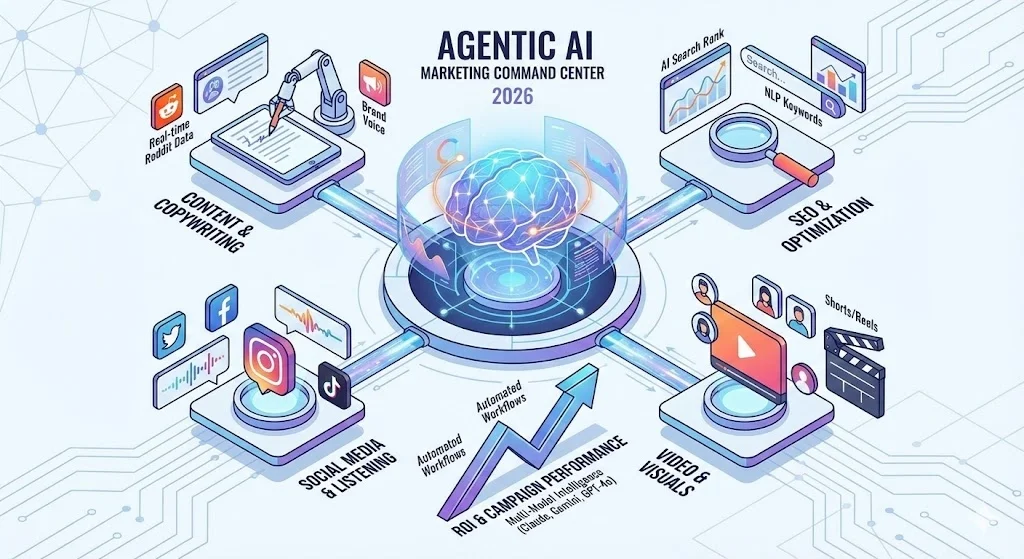
Best AI Marketing Tools for 2026
L’automatisation prédictive : anticiper le comportement client avant qu’il ne se manifeste
L’erreur que 99 % des entreprises font avec l’IA (et comment l’éviter)

AI Won’t Replace You. Using It Wrong Might.